




Bagasse vs Bamboo vs FSC Wood Pulp Packaging Guide
Your quotes come back, and under "raw material" most suppliers list a single line: "paper pulp." No fiber species. No sourcing documentation. Which pulp it is, sugarcane bagasse, bamboo, or FSC-certified wood pulp, changes what you can claim in your sustainability report. It also changes how the finished part looks and what you pay per unit. You have already made the hard decision, fiber over plastic. This guide compares the three fibers that dominate premium wet-pressed molded pulp packaging, so your next RFQ asks the questions most buyers never think to ask.

Why "Paper Pulp" Is Not a Material Specification
"Pulp" is a process input, and that is exactly the problem. Two trays can look identical in a quote PDF and differ in almost everything that matters to a brand. Fiber length drives strength and surface smoothness. Lignin and extractive content drives color and odor. Chain-of-custody documentation decides whether your sustainability claim survives an audit, and whether the origin is agricultural or forestry decides which ESG narrative you can tell.
The blind spot is understandable. Most molded fiber capacity worldwide was built for egg cartons and industrial dunnage, where the fiber source genuinely does not matter. Wet-pressed molded pulp for cosmetics, electronics, wine, and food is a different product category. Here the fiber is visible on the finished surface, sits in direct contact with the product, and appears by name in your packaging sustainability report. In our experience, buyers who treat fiber as a line item get surprised at the sampling stage, when the differences finally show up on the part. This is a product decision, and it belongs early in the spec conversation.

Where Each Fiber Comes From
Sugarcane Bagasse: Upcycled Agricultural Residue
Bagasse is the fibrous residue left after sugarcane stalks are crushed for juice, roughly 25–30% of the cane's weight, or 250–300 kg per tonne of cane processed. The sugar industry generates hundreds of millions of tonnes of it every year, and historically much of it was burned for boiler fuel or simply stockpiled. Sugarcane is an annual crop, harvested every 12–18 months, so the fiber supply renews on an agricultural cycle rather than a forestry one.
That origin is what makes bagasse packaging a genuine circular economy story: the fiber exists whether or not anyone uses it, and no additional land, water, or cultivation goes into producing it. Diverting it into Sugarcane Packaging upcycles a waste stream instead of consuming a primary resource (see our bagasse material line ).
Bamboo Pulp: The Fast-Regenerating Grass
Bamboo is botanically a grass, not a tree, and that distinction drives its sustainability profile. Some species are the fastest-growing plants on earth, with recorded growth of around 91 cm in a single day under optimal conditions. A culm reaches full height in one growing season and harvest maturity in roughly 3–5 years. Most pulpwood trees need 10–30 years.
Bamboo also regenerates from its underground rhizome network. Harvesting a mature culm does not kill the plant, and no replanting is required. A well-managed stand can be selectively cut on an annual rotation, taking around 20% of the inventory each year while the root system stays intact and the soil stays anchored. Bamboo Packaging therefore carries a rapid-regeneration story that no tree-based fiber can match (see our bamboo pulp material line).

FSC-Certified Wood Pulp: The Audited Mainstream Standard
Wood pulp is the incumbent fiber of the global paper industry. What makes it sustainable is the management system around the plant. The Forest Stewardship Council (FSC), an independent non-profit founded in 1994, certifies that forests are managed to defined environmental and social standards (biodiversity protection, responsible harvesting, workers' and community rights), then tracks certified fiber through a Chain of Custody (CoC) system at every step from forest to pulp mill to converter.
Every entity in that chain must hold its own CoC certificate; if one link is missing, the claim breaks. Buyers can verify any supplier's certificate code in FSC's public database at info.fsc.org. That auditability is exactly why FSC packaging remains the most widely recognized and regulator-friendly fiber claim in the US and EU (see our FSC-certified wood pulp line).
Performance Comparison
Fiber choice is a performance decision as much as a sustainability one. The table below summarizes typical behavior in wet-pressed molded pulp applications. Values are directional; exact performance depends on refining, blend ratios, and additives.
|
Property |
Sugarcane Bagasse |
Bamboo Pulp |
FSC Wood Pulp |
|
Fiber length |
Short-to-medium (~1.0–1.7 mm) |
Medium-to-long (~1.5–2.7 mm) |
Softwood long (~2.5–3.5 mm) / hardwood short |
|
Strength profile |
Good stiffness-to-weight; moderate tensile |
High tensile and tear strength |
Highest tensile (softwood); excellent formation |
|
Wet-pressed surface finish |
Smooth, slightly warm/natural tone; fine texture |
Smooth with subtle grain; takes deep colors well |
Smoothest, most uniform; best for light colors and fine detail |
|
Dyeing / color performance |
Best in natural, kraft, and mid-tone shades |
Excellent in dark and premium colorways |
Widest color range; clean whites and pastels |
|
Food contact suitability |
Excellent — long track record in foodservice ware |
Good, with appropriate food-grade formulation |
Excellent, with certified food-grade pulp |
|
Oil & moisture resistance |
Good inherent grease resistance; often PFAS-free by formulation |
Moderate; usually needs additive package |
Moderate; needs additive package |
|
Relative cost level |
Low-to-mid (byproduct economics) |
Mid-to-high (processing intensity) |
Mid (scale economies; FSC premium modest) |
Two practical notes. Surface quality in this category is driven as much by the wet-pressing process as by the fiber. Hot-press molding in fine-machined tooling is what delivers the smooth, print-ready finish that separates premium molded pulp from egg-carton aesthetics (we cover the process in detail in our wet-pressed vs dry-pressed comparison ). Also note that many production runs use engineered blends (bagasse with a long-fiber fraction for strength is a common one), so treat these columns as baselines rather than fixed recipes.
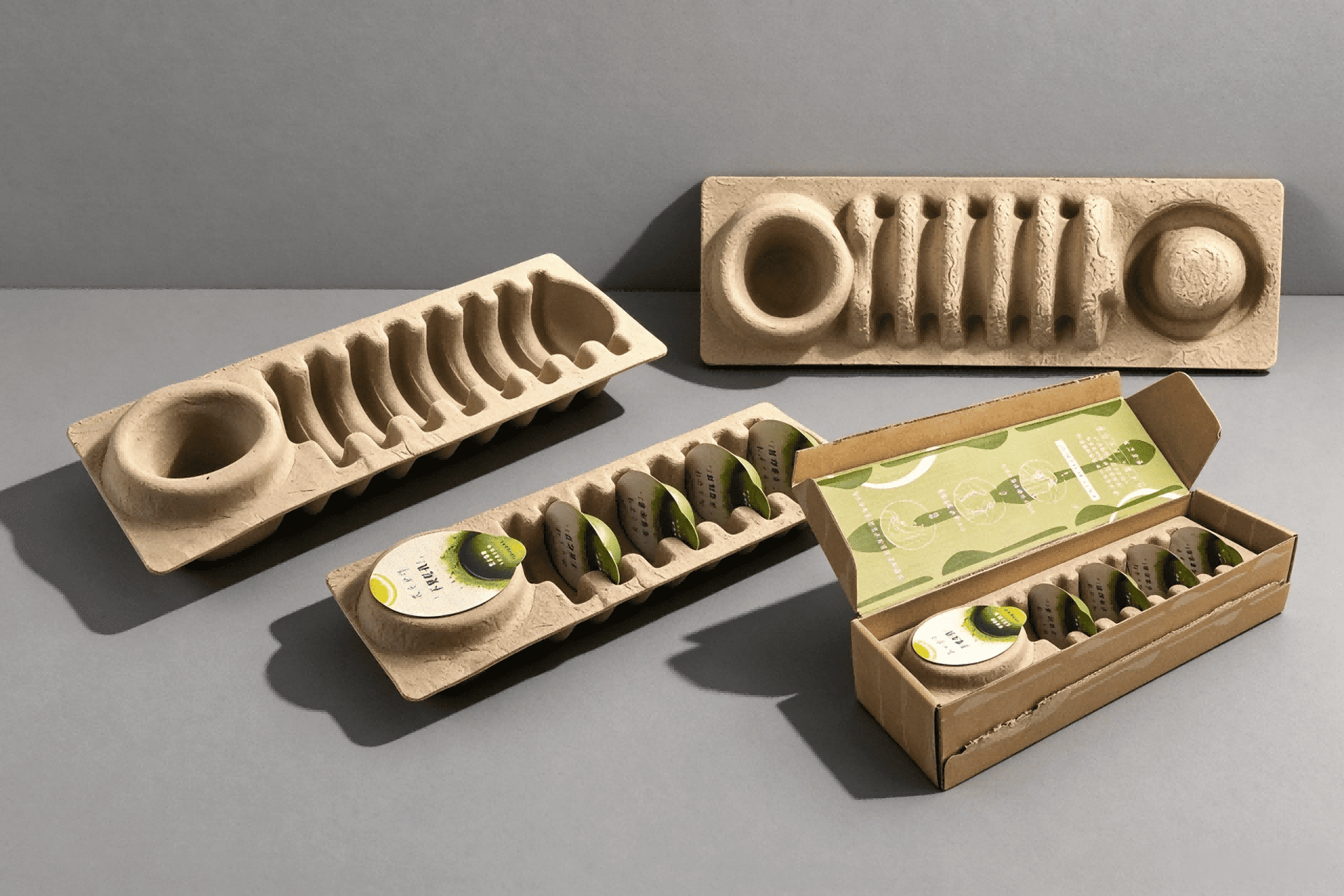
Want to feel the difference before you decide? Ask for fiber samples from all three lines, molded in the same geometry, and compare surface and stiffness on the actual part you plan to produce.
Certifications and Compliance
Compliance claims attach to three separate layers: the fiber, the formulation, and the converter. Buyers conflate them constantly, and that conflation is where greenwashing risk lives.
FSC Chain of Custody applies to wood pulp (and to bamboo where the source plantation is FSC-certified). To print the FSC logo on your packaging, every handler from mill to converter must hold a valid CoC certificate, and the label type must match the invoice: FSC 100%, FSC Mix (certified fiber blended with controlled or recycled sources), or FSC Recycled. Ask for the certificate number and verify it at info.fsc.org. A legitimate supplier provides it without hesitation. Note what FSC does not certify: recyclability, compostability, or food safety. Each requires separate substantiation.
Compostability (EN 13432 in the EU, ASTM D6400 / BPI in the US, TÜV OK compost marks) is a property of the finished article, not the fiber. Put simply: all three fibers are inherently biodegradable cellulose, but the certification tests the whole product (coatings, dyes, and wet-strength or oil-resistance additives included) against disintegration, biodegradation, and ecotoxicity limits. An uncertified additive package can disqualify an otherwise compostable tray.
Food contact (FDA 21 CFR in the US, EU Framework Regulation 1935/2004 and related measures in Europe) again applies to the finished product as manufactured. Bagasse has the longest foodservice track record and wood pulp food grades are well established; bamboo formulations should be documented case by case. In all cases, request a Declaration of Compliance and supporting migration test reports from your supplier.
PFAS-free claims deserve special discipline. "PFAS-free" means no intentionally added fluorinated chemistry in the oil- and grease-resistance package. It is a formulation statement, not a fiber property, and it applies equally across all three fibers only if the supplier's barrier chemistry is genuinely non-fluorinated and supported by test reports. Under the EU Packaging and Packaging Waste Regulation (PPWR), restrictions on PFAS in food-contact packaging and rising documentation duties make this paperwork increasingly non-optional; our EU PPWR compliance checklist covers the full picture.
Carbon Footprint and Biodegradation
Here's the catch with carbon: exact comparative LCA numbers between the three fibers are method-dependent. System boundaries, energy mix, and transport distances move results significantly, so treat any supplier quoting a single precise figure for "the lowest-carbon fiber" with caution. The defensible, directional picture from published LCA literature looks like this:
- Bagassetypically shows the strongest cradle-to-gate advantage, because the fiber is an agricultural byproduct: the cultivation burden is allocated to sugar production, and several peer-reviewed studies find bagasse-based containers reduce life-cycle environmental burden by well over half (in some categories over 70%) versus plastic equivalents.
- Bamboobenefits from rapid biomass accumulation and no replanting, giving low agricultural inputs per tonne of fiber; its footprint is driven more by pulping energy, which varies widely by mill.
- FSC wood pulpcarries the highest upstream forestry burden of the three but benefits from mature, efficient pulping infrastructure and certified land management; its advantage is credibility and scale rather than headline numbers.
Measured against the actual benchmark (plastic), all three sit in the same favorable territory. Molded fiber packaging of any of these fibers typically delivers on the order of 60% lower greenhouse gas emissions than comparable plastic packaging, and roughly 30% lower life-cycle cost than PBAT/PLA bioplastic alternatives when tooling, material, and end-of-life are accounted for. Ask suppliers for product-level LCA or MSDS documentation rather than generic claims; a serious manufacturer can provide both.
On degradation, the widely cited "biodegrades in 90 days" claim is real but conditional. It describes behavior under composting conditions: an active microbial environment, moisture, and elevated temperature in industrial or well-managed home composting. Inert landfill or dry ambient conditions degrade any cellulose product far more slowly. All three fibers meet the 90-day composting benchmark comparably because all are uncoated cellulose. What breaks the claim is the additive package, not the fiber.
Industry × Fiber Fit Matrix
The most practical way to choose is to start from the product category and let the fiber follow. This matrix reflects common pairings we see in wet-pressed premium packaging.
|
Industry |
Primary Recommendation |
Also Works |
Rationale |
|
Beauty & cosmetics |
Bamboo pulp (dark, premium colorways) |
FSC wood pulp (light, clean palettes) |
Bamboo takes deep dyes and reads "natural luxury"; bamboo cosmetic packaging also carries a strong ingredient-adjacent story for clean beauty brands |
|
Consumer electronics (3C) |
FSC wood pulp |
Bamboo pulp |
Long-fiber strength for protective geometry; smooth uniform surface for tight tolerances and brand printing |
|
Wine & spirits |
Bamboo pulp |
Bagasse blends |
Premium tactile feel, dark colorways, drop protection; strong gift-unboxing narrative |
|
Food & foodservice |
Sugarcane bagasse |
FSC wood pulp |
Byproduct economics at volume, inherent grease resistance, established food-contact track record |
|
Premium gift & rigid-style boxes |
FSC wood pulp (light/fine detail) |
Bamboo (dark contrast elements) |
Smoothest finish for embossing, debossing, and light colors; bamboo for two-tone or accent inserts |
Two anonymous snapshots illustrate the logic. A European clean-beauty brand switching from plastic inserts chose bamboo because the dark, naturally grained tray photographed like a material swatch; the packaging became part of the product page. A US food brand chose bagasse for a blunter reason: its sustainability team could write "made from upcycled sugarcane fiber" on-pack with zero supply risk, given the sheer scale of global bagasse availability.
The Narrative Value
Your fiber choice is also your copy deck. Each fiber supports a different, defensible story:
- Bagasse = circular economy."Our packaging is made from the fiber left over after sugar production, a byproduct that would otherwise be burned." This is the strongest waste-diversion narrative and the easiest for consumers to grasp. In ESG reporting, frame it as agricultural residue valorization with avoided open burning.
- Bamboo = rapid regeneration."Bamboo grows back from its own root system, needs no replanting, and matures in 3–5 years." It also carries an Eastern material-heritage resonance that suits design-led brands. In ESG reports, frame it as renewable feedstock with minimal land disturbance, but avoid unverified carbon-sequestration numbers, which vary enormously by plantation.
- FSC wood pulp = the mainstream trust mark."Certified by the world's most recognized forest standard, traceable through an audited chain of custody." It is the least exotic story and the most audit-proof one, ideal for listed companies whose claims face investor and regulator scrutiny, and increasingly useful as EUDR and PPWR due-diligence regimes tighten.
Whichever fiber you choose, align the paperwork: the on-pack claim, the supplier's certification documents, and the ESG report paragraph need to say the same thing. Regulators on both sides of the Atlantic (FTC Green Guides, EU Green Claims Directive, PPWR enforcement) are increasingly checking that these three agree; our PPWR compliance hub covers the documentation framework.
Procurement Checklist: 6 Questions to Ask Your Supplier
Before signing off on a fiber, get written answers to:
- What is the exact fiber species and blend ratio?"Paper pulp" is not an answer. Get the species, the blend percentages, and whether ratios are guaranteed per batch.
- Can you provide chain-of-custody documentation?For wood/bamboo: the FSC certificate number (FSC-CXXXXXX), its scope, and expiry. Then verify it yourself at info.fsc.org. For bagasse: documentation of the sugar-mill source region.
- Is the barrier/additive package PFAS-free, and can I see the test reports?Ask specifically what provides oil and moisture resistance, and for third-party total-fluorine or PFAS screening results.
- What food-contact and compostability certifications apply to the finished article?Request Declarations of Compliance (FDA / EU 1935/2004) and EN 13432 / ASTM D6400 / OK compost certificates in the supplier's name, not a raw-material datasheet.
- Can you provide product-level LCA or MSDS documentation?This is what your own sustainability report will cite; generic industry averages are not enough.
- How consistent is supply, and what is the contingency?Bagasse supply tracks the sugar-crushing season; bamboo pulp capacity is concentrated regionally. Ask about buffer stock and dual-source options before you commit a product line.
FAQ
Which fiber is the most sustainable overall?
The honest answer: there is no universal winner, because it depends on what you weight. Bagasse leads on waste diversion and typically on cradle-to-gate carbon; bamboo leads on renewability speed and land efficiency. FSC wood pulp leads on verified, auditable sourcing at scale. Against plastic, all three are dramatic improvements, so the more useful question is which fiber best fits your product category and compliance needs.
Is bagasse packaging safe for direct food contact?
Yes, bagasse has the longest foodservice track record of the three and good inherent grease resistance. The qualification is that food-contact compliance attaches to the finished product (fiber plus additives), so always request the supplier's Declaration of Compliance and migration test reports rather than relying on the fiber's reputation alone.
Does bamboo packaging cost more than wood pulp?
Generally, yes. Bamboo pulp involves more processing and its supply base is more concentrated, so expect a mid-to-high relative cost position versus wood pulp's mid position. Bagasse usually sits lowest thanks to byproduct economics. Blends can close the gap: a bamboo-surface/wood-core structure, for example, delivers bamboo aesthetics at closer to wood-pulp cost.
Can I put the FSC logo on bamboo or bagasse packaging?
Only if the specific fiber source is FSC-certified and every handler in the chain, including your converter, holds a valid Chain of Custody certificate. FSC certifies bamboo plantations as well as forests. Bagasse, being an agricultural byproduct rather than a forest product, is typically not FSC-covered; its credibility comes from the byproduct story and compostability certifications instead.
What does "biodegrades in 90 days" actually guarantee?
It describes certified behavior under composting conditions, not disappearance in any environment. Verify which standard backs the claim (EN 13432, ASTM D6400, or OK compost), confirm the certificate covers the finished article including its additive package, and phrase consumer-facing copy accordingly to stay clear of greenwashing rules.
The Bottom Line
"Paper pulp" is where the specification conversation starts. Bagasse, bamboo, and FSC-certified wood pulp each bring a different performance profile, compliance file, and brand story, and the right choice depends on your product category, color palette, food-contact needs, and ESG reporting requirements. In our experience, the brands that get this decision right ask suppliers the six questions above before the first tooling dollar is spent; the ones that skip them discover the difference after the first production run.
Ready to compare the three fibers on your actual product? Request fiber samples from all three lines in the same geometry, along with the full documentation package (FSC certificates, PFAS-free test reports, LCA/MSDS). That is what your sustainability claim will rest on.