Refillable packaging has crossed from niche eco-gesture into the mainstream procurement agenda. In 2026, beauty brands are past asking whether to offer refills. The open questions are which refill architecture to build and which supplier can engineer it at scale.
Regulation is one driver. The EU's Packaging and Packaging Waste Regulation (PPWR) entered into force in February 2025 and begins applying in August 2026, with mandatory reuse targets from 2030. Cost is the other. A well-designed refill system moves repeat purchases onto a low-cost inner unit, which trims per-unit packaging spend and keeps the repeat buy inside the brand. If you followed the conceptual debate in our earlier piece on refillable vs single-use beauty packaging , this guide is the next step: the market numbers and the exact questions procurement teams now put to suppliers.
Packaging buyer or sustainability lead, you should leave this article with two things: the data to build the business case, and a checklist for the supplier conversation.
Key Takeaways
- The cosmetic refill packaging market is estimated at USD 7.25 billion in 2025, on track for USD 10.8 billion by 2032 (CAGR ~5.9%). Refillable cartridges and pods are growing faster still (8%+ CAGR) than the category average.
- The EU PPWR (Regulation (EU) 2025/40) applies from 12 August 2026 and sets binding reuse targets from 2030; France's AGEC law already requires larger companies to reach 10% reused packaging by 2027.
- Four refill architectures dominate beauty: cartridge, pod, pan, and in-store refill, each with its own tolerance and hygiene requirements.
- Hybrid systems (durable outer case plus compostable molded pulp inner core) are emerging as the lowest-risk route to plastic reduction, especially for lip, stick, and powder formats.
- Suppliers should be evaluated on five engineering questions: tooling precision, refill-interface tolerances, outer-case compatibility, MOQ flexibility, and test validation documentation.
The Refillable Packaging Market in 2026: What the Numbers Say
Market sizing for refillable beauty packaging varies by scope, so treat any single figure as directional. We would not build a board deck on one number alone. That said, three consistent signals do emerge across recent reports:
Refillable cosmetic packaging overall: valued around USD 7.25 billion in 2025 and projected to reach USD 10.8 billion by 2032, a CAGR of roughly 5.9% (PW Consulting, 2025). Europe holds the largest regional share at around USD 2.5 billion.
Refill and reuse systems in cosmetics specifically: estimated at USD 8.4 billion in 2025 and forecast to reach USD 11.6 billion by 2030, a 6.6% CAGR, with Asia Pacific the fastest-growing region (industry estimates, 2025).
High-growth sub-segments: refillable cosmetic cartridges, the replaceable inner units at the heart of most systems, were sized at USD 1.37 billion in 2024 and are forecast to grow at 8.2% CAGR through 2033 (Growth Market Reports). Refillable beauty products at the SKU level are projected to grow from USD 732 million in 2024 to USD 1.18 billion by 2031, a 7.1% CAGR (QYResearch).
For procurement teams, two readings matter. First, anyone tracking refillable packaging trends can see the inner unit is growing faster than the outer system. Cartridges and pods outpace the category. In our own project pipeline, that is exactly where the engineering effort is going, and where the margin will concentrate. Second, color cosmetics is the fastest-adopting segment of refillable cosmetic packaging. Lip, stick, and powder formats are structurally easier to refill than liquids, which is why refillable lipstick cases, refillable lip balm tubes, and powder compact pans dominate early launches.
The commercial logic matters as much as the growth rate. A refill model converts packaging from a repeated cost into a retention device: the consumer buys the durable case once, then repurchases a cheaper refill at 60–80% of the full-unit price. Brands that execute this well report refill repurchase as a measurable loyalty channel, a pattern consistent with reuse and refill research from the Ellen MacArthur Foundation. None of it works, though, if the refill does not feel effortless. That comes down to engineering.
Considering a refill line for 2026? Request a refill-structure feasibility review. We assess your format, volume, and material options and return a manufacturability report within one week.
The Regulatory Engine: PPWR and AGEC
Refill is no longer optional brand theater. In the EU, and for any brand selling into it, reuse is becoming a compliance variable.
EU PPWR: reuse enters the rulebook
Regulation (EU) 2025/40, the Packaging and Packaging Waste Regulation, entered into force on 11 February 2025 and applies from 12 August 2026. For refill strategy, three provisions matter most:
Reuse targets (Article 29): from 1 January 2030, minimum shares of packaging placed on the market must be reusable: 40% for transport packaging, rising to 70% by 2040; 10% for grouped packaging, 25% by 2040; 10% for most beverage packaging, 40% by 2040; 10% for e-commerce delivery packaging, 50% by 2040.
Definition of reusable packaging (Article 11): packaging counts as reusable only if it is designed for multiple rotations and operates within an organized return/refill system. A "refillable" lipstick that consumers never refill will not survive this definition. Design for actual rotation, not nominal capability.
Recyclability gates: from 2030, packaging must meet recyclability performance grades (A–C, ≥70% recyclable); from 2038, only grades A and B can be placed on the market.
For a clause-by-clause breakdown, see our PPWR compliance checklist for beauty and food brands.
France AGEC: the national accelerant
France's AGEC law goes further and faster. Key provisions affecting beauty packaging:
Phase-out of single-use plastic packaging by 2040, staged through five-year "3R" decrees (Reduce, Reuse, Recycle).
The 2021–2025 decree required a 20% reduction in single-use plastic packaging versus 2018, with at least half achieved through reuse. Refill devices are explicitly named as a qualifying route.
Reuse quotas: 5% of packaging placed on the French market by 2023, rising to 10% by 2027 (companies above €50M turnover faced a 7% interim target at end-2025).
Claim discipline: terms like "biodegradable" or "environmentally friendly" are banned on packaging. Substantiation vocabulary matters.
France is also where reuse is being stress-tested at retail scale. The 2025 "La Boucle Beauté Parfums" pilot ran perfume bottle returns across 192 stores, with Dior, Estée Lauder, Diptyque, and others participating. That is return-and-refill logistics moving from pilot to infrastructure.
The practical consequence for a US or EU brand: your 2026 packaging roadmap will be audited against 2030 reuse targets. Building refill capability now is cheaper than retrofitting compliance in 2029. Track every deadline and provision in our PPWR compliance hub.
The Four Refill Formats: An Engineering Map
"Refillable" describes a business model, not a structure. In practice, beauty refill systems cluster into four architectures, each with different engineering stakes.
1. Cartridge (replaceable inner core)
The consumer keeps a durable outer case (often metal, glass, or thick-wall plastic) and swaps a self-contained inner cartridge. Typical for skincare airless pumps, fragrance vials, and stick products.
Engineering stakes: the cartridge-to-case interface must survive dozens of insert/remove cycles without wear; bayonet, snap-fit, or magnetic locks each carry different tolerance chains.
2. Pod (sealed capsule)
A sealed, often single-dose or short-cycle capsule dropped into a reusable device, common in premium skincare and device-led beauty. The pod carries the hygiene barrier; the device carries the durability.
Engineering stakes: seal integrity, peel/open force, and material compatibility with active formulas. Pods tolerate less structural abuse than cartridges, so transit packaging does more work.
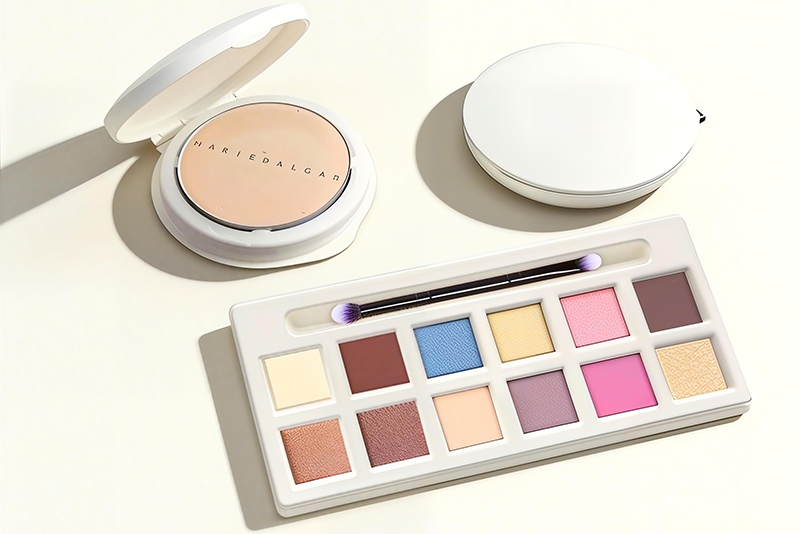
3. Pan (pressed-powder insert)
The workhorse of refillable color cosmetics: a pressed powder pan (traditionally tinplate or aluminum) that drops into a magnetic or friction-fit well in a compact. Blush, eyeshadow, and face powder live here. See our engineering refillable powder compact case study .
Engineering stakes: pan flatness and diameter tolerance (±0.1 mm is a realistic working band for drop-in fit), magnet retention force, and corrosion behavior of the pan metal against formula. This is the most mature refill format, and the one where molded fiber inserts are gaining ground fastest.
4. In-store refill (bulk dispensing)
The consumer brings (or buys once) a durable container and refills from bulk dispensers: shampoos, body wash, and increasingly fragrance, as the French perfume pilots show.
Engineering stakes shift upstream. Dispenser hygiene and container cleanability now matter more than anything on the bottle itself, and EPR reporting gets more demanding. The primary pack becomes industrial; the consumer pack becomes an appliance.
Comparison at a glance
The table below compares the four refillable packaging formats across six procurement dimensions:
|
Dimension
|
Cartridge
|
Pod
|
Pan
|
In-store refill
|
|
Best-fit categories
|
Skincare, sticks, fragrance
|
Premium skincare, devices
|
Pressed powder color cosmetics
|
Liquids: hair, body, fragrance
|
|
Consumer effort
|
Low (swap)
|
Low (drop in)
|
Low (drop in)
|
High (travel + refill act)
|
|
Hygiene barrier
|
Medium
|
High (sealed)
|
Medium
|
Depends on dispenser ops
|
|
Tolerance criticality
|
High (interface cycles)
|
Medium (seal force)
|
High (pan fit, ±0.1 mm)
|
Low on pack, high on dispenser
|
|
Molded pulp opportunity
|
Inner core / tray
|
Transit + pod tray
|
Pan carrier / insert
|
Secondary packaging
|
|
Material reduction vs. single-use
|
50–70%
|
40–60%
|
60–80%
|
Up to 90% (logistics dependent)
|
Where Molded Pulp Cores Fit in Hybrid Refill Systems
Most refill packaging discussions miss a structural point: the most durable part of a refill system should stay durable, and the most disposable part should compost. Mix those roles up (a plastic refill inside a plastic case) and most of the single-use plastic stays exactly where it was.
The emerging answer is the hybrid refill system: a permanent outer case (aluminum, bamboo, or rigid board) paired with a wet-pressed molded pulp inner core that holds the formula or carries the pan and is composted or recycled after each refill cycle.
Wet-pressed molded pulp earns this role on engineering merit:
Dimensional precision: wet-pressing produces smooth, tight-tolerance surfaces, the difference between a refill core that clicks into place and one that rattles. Tolerances in the ±0.2–0.3 mm band are achievable on critical features, sufficient for friction-fit and snap interfaces in stick and balm formats. For a process-level breakdown, see wet-pressed and dry-pressed molded pulp.
Thin-wall capability: wall sections down to roughly 0.6–0.8 mm keep the refill core light, so the material mass between purchases disappears in the refill rather than the case.
Material story with documentation: Esen's three pulp lines (FSC-certified wood pulp, bagasse, and bamboo) let brands tune the fiber narrative to their positioning. FDA and REACH compliance files, plus MSDS and LCA documentation, back the claims that PPWR-era reporting increasingly demands. For a material-level comparison, see bagasse vs. bamboo vs. FSC wood pulp.
End-of-life clarity: a molded fiber refill core biodegrades in around 90 days under composting conditions and, unlike "compostable" bioplastics, carries no industrial-composting asterisk. It is a claim that survives France's AGEC claim discipline.
Here is a composite scenario, drawn from patterns in our development conversations rather than one specific project. A European color cosmetics brand is speccing a refillable lip balm tube for a 2027 spring line. The outer case: anodized aluminum, premium, designed to be kept for years. The refill core, which touches the formula, would typically be PP. In feasibility work on this type of system, switching that core to a thin-wall molded pulp insert with a food-contact-safe liner removes roughly 70% of the plastic in the refill unit (illustrative figure), while the twist-up mechanism and the existing filling line stay unchanged. Only the core geometry changes. That is the hybrid pattern: fix the system, change only the disposable layer. We've applied the same insert engineering in a molded pulp insert program for a cosmetic gift set.
The same logic scales to deodorant-style sticks and balm formats, the category behind our molded fiber deodorant tube packaging. Where a full pulp tube suits the brand, a monomaterial fiber system removes the hybrid question entirely; where a premium outer case is non-negotiable, the pulp inner core does the reduction work.
Want to test a molded pulp core against your current refill spec? Send us your outer-case drawing and target volume. We will return tolerance feedback and a tooling estimate. Start the feasibility review .
Five Engineering Questions to Ask Your Refillable Packaging Supplier
Across supplier evaluations, the same five questions separate vendors who can talk refill from those who can ship it. We sit on the supplier side of this table, and we would still recommend putting them verbatim into your next RFQ.
What tooling precision do you hold on the refill interface?
How do you validate fit across the full tolerance stack?
Is the refill compatible with our existing outer-case platform?
What are the real MOQs at tooling, first run, and reorder?
What test validation and compliance documentation ship with the product?
1. What tooling precision do you hold on the refill interface?
The refill-to-case interface is where tolerance failures show up first. Ask for the tolerance band on the features that mate with the outer case, and whether that band is measured on first articles or production samples after 10,000 cycles. For molded parts, ask how tooling maintenance intervals affect drift over a multi-year program.
2. How do you validate the fit across the full tolerance stack?
Your outer case comes from one supplier, the refill from another. Who owns the stack-up analysis? A capable refill supplier will run gauge testing against your case's worst-case dimensions (MMC/LMC). Ask for the gauge report format before you commit.
3. Is the refill compatible with our existing outer-case platform, or does it lock us into yours?
Open-interface refills preserve your freedom; proprietary interfaces transfer leverage to the supplier. Clarify who owns the interface geometry, whether the tooling is portable, and what happens to unit cost if you dual-source the refill later.
4. What are the real MOQs for tooling, for first run, and for reorders?
Refill programs start small and scale with repurchase rates. The honest answer to listen for: a supplier whose economics only work at 500k units per SKU is a mismatch for a 30k-unit pilot. Ask for MOQ at three stages (pilot tooling, launch volume, steady-state reorder) plus lead times at each stage.
5. What test validation and compliance documentation ship with the product?
In the PPWR era, the paperwork is part of the product. Minimum package: drop and cycle testing on the assembled system, transit testing on the refill as shipped, and material compliance files (FDA/REACH where relevant, MSDS). Increasingly, expect to supply LCA data as well, to substantiate your reduction claims under the AGEC/PPWR claim rules. If a supplier treats documentation as an upsell, price that in.
A supplier who answers all five with data rather than adjectives has shipped refill systems before.
Procurement Checklist and FAQ
Refillable packaging sourcing checklist
Refill format selected against category (cartridge / pod / pan / in-store) and consumer effort budget
Interface tolerance band agreed in writing, with worst-case gauge validation
Outer-case compatibility confirmed across the full tolerance stack
MOQ and lead time mapped at pilot, launch, and reorder stages
Material compliance files in hand: FDA/REACH, MSDS, LCA
Claim language reviewed against AGEC restrictions (no unqualified "biodegradable")
PPWR Article 11 test applied: does the system enable actual rotation, not nominal refillability?
End-of-life route defined for the refill unit (compost, paper stream, return)
FAQ
What is refillable packaging in beauty, exactly? A system where the consumer retains a durable outer component and replaces only the inner unit: cartridge, pod, pan, or in-store refill. Under EU PPWR Article 11, it must be designed for multiple rotations within an organized system to count as reusable.
Which refill format should a color cosmetics brand start with? Pan-based systems (powder compacts) and cartridge systems (lipstick, lip balm) are the lowest-risk entries: consumer behavior is already established, tolerance engineering is mature, and molded fiber inner components can replace plastic without touching the filling line.
Does molded pulp survive contact with cosmetic formulas? Wet-pressed molded pulp with an appropriate food-contact-safe liner or coating handles balm, stick, and powder applications. For water-based liquids, pulp typically plays the secondary role (trays, inserts, transit), while the primary barrier remains a liner or thin inner vessel.
What certifications should a refillable packaging supplier provide? At minimum: FSC chain-of-custody for fiber-based parts, FDA and EU food-contact compliance where formulas contact the pack, REACH SVHC screening, MSDS per material, and an LCA or carbon footprint summary to support your marketing claims under tightening EU rules.
How do PPWR reuse targets affect a brand outside the EU? If you sell into the EU, you are an "economic operator" under the PPWR. The reuse, recyclability, and reporting provisions apply to your packaging regardless of where it is manufactured. Non-EU brands should treat August 2026 as their own compliance deadline.
Conclusion
The market is around USD 7–8 billion and growing at 6% or better. The regulatory calendar makes reuse a compliance variable from 2030. And the four refill architectures are mature enough to source now. The brands moving fastest share a pattern: they pick the format that fits their category, then hybridize (durable case, compostable molded pulp core), and they qualify suppliers on documented tolerance data.
Your next step is concrete. Shortlist one SKU where a refill architecture makes commercial sense, and pressure-test it against the five supplier questions above. If a molded pulp inner core or fiber-based refill format is on your shortlist, our engineering team will review your drawings and return a feasibility assessment within one week. Request your refill-structure feasibility review .
Written by the Esen Engineering Team, a wet-pressed molded pulp packaging manufacturer for beauty and personal care brands.