




Wet-Pressed vs Dry-Pressed Molded Pulp: Thermoformed Guide
Two suppliers quote you for "molded pulp packaging." One comes back at $0.18 per unit with a matte, carton-smooth insert that holds your serum bottle like a watch in a jeweler's box. The other quotes $0.06, and the sample looks like an egg carton. Both are technically correct. The difference is that one part is wet-pressed and the other is dry-pressed molded pulp. If you don't specify which process you need, you'll get whichever one the factory happens to run.
For packaging buyers and structural engineers at US and EU brands, this is one of the most expensive vocabulary gaps in sustainable sourcing. "Molded pulp" covers a whole family of processes, with dramatically different surface quality, tolerances, tooling costs, and unit economics. Choose wrong, and you either overpay for a utility part or ship a premium product in packaging that undermines the brand.
This guide explains both processes in plain engineering language, compares finished-part quality and cost structure side by side, maps applications to the right process, and ends with a six-question checklist for your next RFQ.
Why "Molded Pulp" Quotes Vary So Widely
Every molded pulp part starts the same way: plant fiber (wood pulp, bagasse, bamboo, or recycled paper) is dispersed in water to form a slurry, then vacuum-formed onto a screen mold so the fibers deposit into a wet "preform." At this point the two processes diverge, and everything a buyer cares about, from surface and tolerance to strength and price, diverges with them.
The short version: wet pressing dries the part inside a heated, matched mold under pressure; dry pressing dries it in open hot air after forming. One is a precision molding operation. The other is closer to shaped paper making. Neither is "better." They serve different products, and the price gap between them (often 2–3x per unit) only makes sense once you understand what the extra money buys.
How Each Process Works
Wet-Pressed (Thermoformed) Molded Pulp
After vacuum forming, the wet preform, still saturated at roughly 70–75% water content, is transferred into a matched pair of heated metal molds. The molds close under pressure, squeezing water out mechanically while heat drives off the remainder. The part is pressed, densified, and dried in a single operation, with both faces formed against precision-machined tooling surfaces.
This is why the industry calls it thermoformed molded pulp ("type 4" in older ASTM classifications). When a supplier or a sustainability report mentions thermoformed packaging made from fiber, or uses the phrase thermoformed molded fiber in a catalog, they almost always mean this process. It's also the capability buyers are really searching for when they type "wet pressed molded pulp" into a supplier directory. The name captures the defining step: heat plus pressure inside a closed mold, with wet fiber as the raw material instead of a plastic sheet.
That single step changes the finished part in three ways:
- Mechanical pressing compacts the fiber network, producing a thin, stiff, dense wall, typically 0.8–2.0 mm.
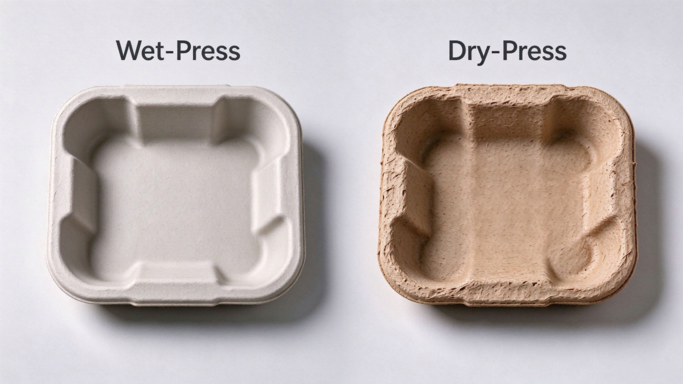
- Both faces take the finish of the mold, so the surface comes out smooth and uniform, with no screen-mesh marks, and takes printing, embossing, and debossing well.
- Because the part cures between matched dies, dimensional tolerances tighten to roughly ±0.2–0.5 mm, and fine details such as sharp-ish radii below 1 mm, embossed logos, and thin ribs reproduce faithfully.
Dry-Pressed Molded Pulp
Dry pressing (also called transfer molding; its newest variants go by "dry molded fiber," more on that below) skips the in-mold drying step. The wet preform is vacuum-formed on a single-sided screen mold, then transferred to a drying line: a convection oven, a heated conveyor, or in the lowest-cost setups, ambient air. The part dries from its own surfaces inward, unconstrained, and shrinks slightly as it does.
Because nothing presses the fiber against a polished die, the finished part keeps a porous, textured surface with a visible mesh pattern on the mold side. Walls run thicker and less uniform, typically 1.5–3.0 mm, and dimensional tolerances sit in the ±1–2 mm band. Tooling is simpler (a forming mold plus transfer tooling, no heated matched dies), cycle times are faster at scale, and energy per part is lower.
That combination of cheap tooling, fast output, and forgiving geometry is why dry pressing dominates egg cartons, fruit trays, drink carriers, industrial cushioning, and every other application where the part does a job but is never scrutinized by an end consumer.

Finished-Part Differences at a Glance
|
Dimension |
Wet-Pressed |
Dry-Pressed |
|
Surface finish |
Smooth, dense, both faces; matte to semi-gloss; no mesh marks |
Porous, textured; visible fiber and screen pattern; slight linting possible |
|
Wall thickness |
~0.8–2.0 mm, highly uniform |
~1.5–3.0 mm, varies across the part |
|
Detail reproduction |
Fine: radii below ~1 mm, embossed/debossed logos, thin ribs, crisp edges |
Coarse: generous radii needed; fine text and logos blur |
|
Color & dyeing |
Full range: white, black, custom Pantone-referenced colors dyed through the slurry; printable surface |
Mostly natural beige/brown/grey; dyeing uneven on porous surface; printing possible but soft |
|
Dimensional tolerance |
~±0.2–0.5 mm |
~±1–2 mm |
|
Strength character |
Rigid, high compressive and stacking strength; holds precise fits |
Flexible, conforming; superior shock absorption and cushioning |
|
Typical fiber |
Virgin fiber typical (wood, bagasse, bamboo) for finish and food contact |
Recycled fiber common; virgin used when color or food contact requires |
|
Feel in hand |
Like dense paperboard or a rigid plastic tray |
Like an egg carton, because that's what it is |
One nuance: the "strength" row cuts both ways. Wet-pressed parts are stiffer, but dry-pressed parts absorb impact better precisely because they're softer. For heavy industrial components in transit, egg-carton physics are a feature, not a bug.
Color matters too if you're speccing to a brand palette. Wet pressing locks through-dyed pigment into a dense, smooth matrix, so black stays black under retail lighting instead of reading as dark brown. Our sugarcane bagasse and FSC-certified wood pulp material pages show how fiber choice interacts with color and surface on real product lines.
Cost Structure: Tooling, Unit Price, Cycle Time, Energy
The processes differ on every line of the cost sheet. Unit price is only one of them:
|
Cost factor |
Wet-Pressed |
Dry-Pressed |
|
Tooling (one-time) |
Matched heated dies, precision-machined: typically several thousand to ~$15k+ per SKU depending on cavities and complexity |
Single-sided forming mold + transfer tooling: typically $1k–5k per SKU |
|
Tooling lead time |
Longer: heated matched dies take more machining and debugging (often 3–6 weeks) |
Shorter (often 2–4 weeks) |
|
Unit cost |
Higher: commonly 2–3x dry press for equivalent geometry |
Lowest in the molded pulp family |
|
Cycle time / output |
Slower; pressing and in-mold drying bound the cycle |
Faster; drying line runs continuously, high parts-per-hour at scale |
|
Energy per part |
Higher (heated pressing) |
Lower per part, though total drying energy is significant at scale |
|
Economic break-even |
Justified when finish/precision drives pack-out value or replaces plastic trays |
Wins on pure cost-per-part for protective/utility applications |
Where's the volume tipping point? There's no universal number; geometry and cavity count dominate. But here's a rule of thumb from production practice: wet pressing starts to make economic sense when the packaging is part of the product experience (unboxing, shelf presence, brand contact) and annual volumes justify amortizing matched dies, typically from the tens of thousands of units upward. Below that, semi-wet press (a partially dried preform, then a lighter hot press) can deliver 80% of the finish at meaningfully lower tooling cost. In our experience, more buyers sit in that awkward middle than expect to, so it's worth asking about.
Energy is the counterintuitive line. Wet pressing uses more per part (heated dies), but the denser part can use less fiber for equivalent rigidity. Either way, both processes undercut plastic decisively. Our LCA documentation puts molded pulp at roughly 60% lower CO₂ than comparable plastic packaging, with 90-day biodegradability and about 30% lower lifecycle cost than PBAT/PLA alternatives. Process choice rarely changes the sustainability verdict; it changes finish and unit economics.
Working through a packaging spec right now? Send us your product drawings (STEP/IGS/SolidWorks) and annual volume estimate. We'll recommend wet press, dry press, or semi-wet with a costed comparison, before you commit to tooling. [Contact Esen's engineering team →]
Which Process Fits Your Product? A Scenario Matrix
|
Your product |
Recommended process |
Why |
|
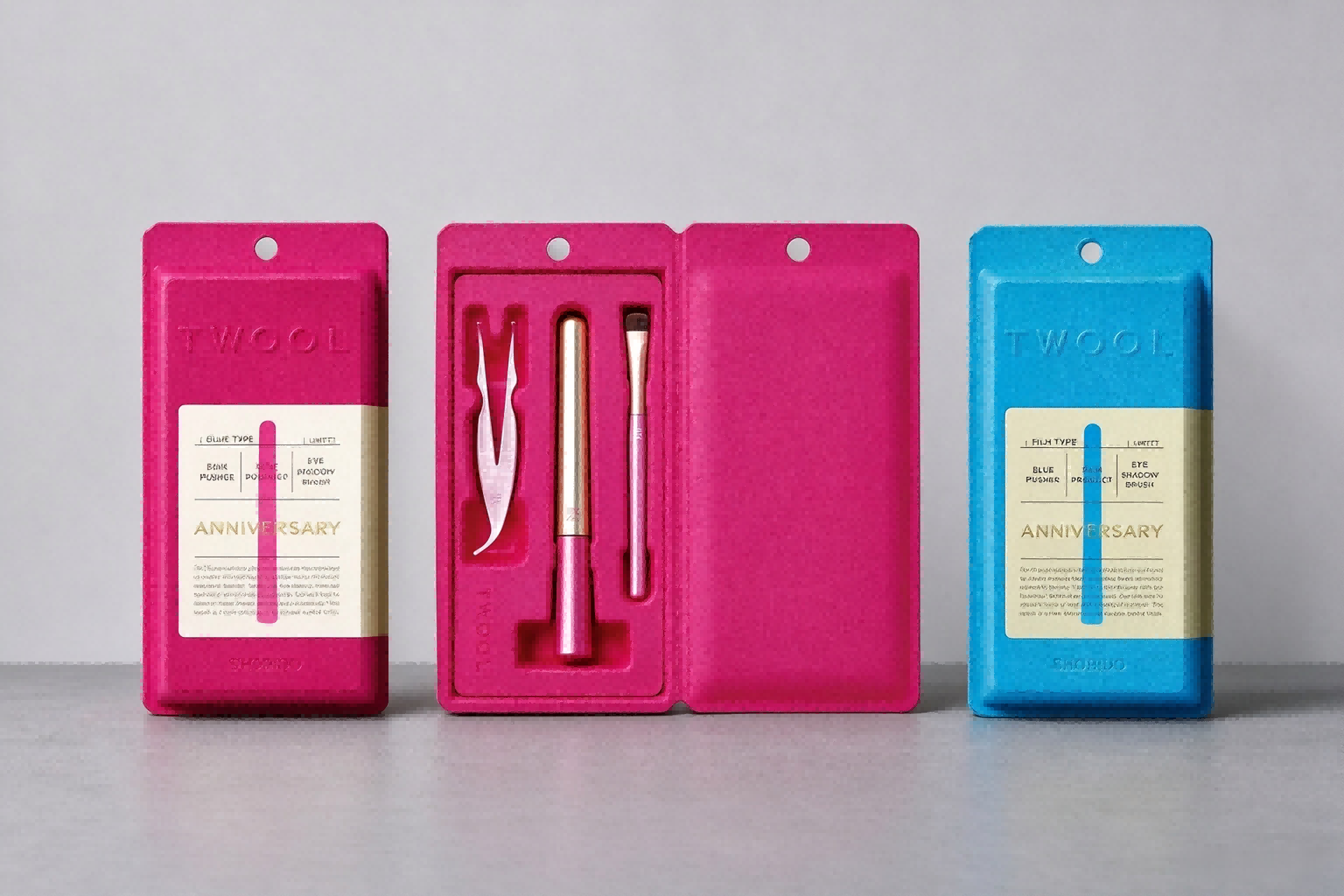
Cosmetics & skincare (jars, serums, palettes) |
Wet-pressed |
Consumer-facing; unboxing photographed; needs smooth dyed surface and precise fits |
|
Consumer electronics (phones, earbuds, wearables) |
Wet-pressed |
Tight tolerances, ESD-safe fiber options, premium retail presentation |
|
Wine & spirits gift boxes |
Wet-pressed |
Presentation-grade finish, embossing for branding, stacking strength |
|
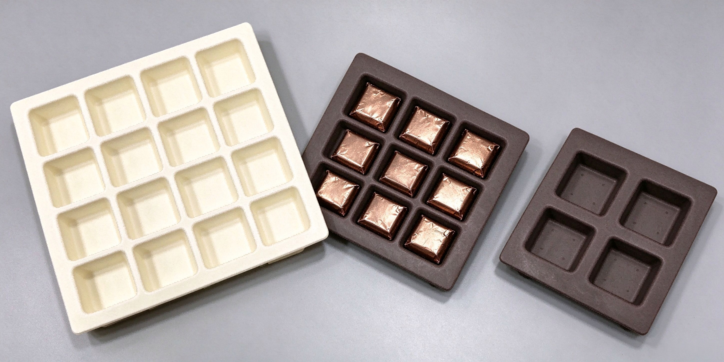
Premium confectionery (chocolate trays, advent calendars) |
Wet-pressed |
Food-contact surface quality, fine cavity detail, color capability |
|
High-end gift / PR boxes |
Wet-pressed |
The packaging is the product's first impression |
|
Medical & diagnostic device trays |
Wet-pressed |
Precision, clean low-lint surface, documentation-friendly |
|
Egg cartons & produce trays |
Dry-pressed |
Utility part, massive volume, cost-per-part is everything |
|
Industrial cushioning & end caps |
Dry-pressed |
Shock absorption beats stiffness; hidden inside the shipper |
|
Foodservice trays, cup carriers, clamshells |
Dry-pressed |
High volume, adequate function, compostability is the selling point |
|
Nursery / seedling pots |
Dry-pressed |
Designed to decompose in soil; finish irrelevant |
|
E-commerce protective mailers & inserts |
Dry-pressed (usually) |
Protective, not presentational, unless the insert is part of unboxing |
A quick heuristic: if the end customer will touch it, photograph it, or judge the brand by it, wet press. If it protects something on the way to a customer who will never see it, dry press.
A cosmetics brand we worked with asked for "the cheapest molded pulp insert" for a skincare gift set. The dry-press sample protected the jars perfectly. It also looked like it belonged in a hardware store. We ran the same geometry in wet-pressed bagasse, through-dyed to the brand's off-white, and the insert became the most-photographed element of the unboxing. Unit cost roughly doubled, yet still came in below the ribbon it replaced. The reverse mistake happens too: wet-press prices paid for warehouse-only dunnage. Both are specification failures, not process failures.
For electronics specifically, the calculus often involves replacing EPS foam entirely. Our EPS-to-molded-pulp electronics case study walks through how an electronics brand navigated the EPS-to-fiber transition, including which parts stayed protective-grade and which went presentation-grade.
The Rise of Dry Molded Fiber: Is the Gap Closing?
Honest answer: partially, and it's worth watching.
A newer process family, dry molded fiber (DMF), pioneered and licensed by Sweden's PulPac and adopted by licensees in Europe and Asia through 2024–2025, forms fiber with minimal water and presses it dry at high speed. The technology claims production speeds approaching plastic forming lines, far lower water and energy use than conventional wet molding, and surface quality well above traditional dry press. Commercial applications have moved from coffee lids into trays, closures, and food-service items, with machines now running commercially in Sweden, Malaysia, and Japan. One caveat: those are vendor claims and early adoption figures, not something we can yet quote from our own lines.
What that means for a buyer today:
- DMF is real and scaling, but access runs through technology licensees; the supplier base is still a fraction of conventional molded pulp capacity.
- It targets the middle.Better finish than dry press, faster and cheaper than wet press, rather than replacing either extreme. The smoothest wet-press finish remains the benchmark for luxury unboxing.
- For high-volume food-service and lid applications, DMF may already be the best cost-and-carbon answer. For a black-dyed cosmetics clamshell with an embossed logo, wet pressing remains the safer spec today.
We run both wet-pressed and dry-pressed lines and track DMF development closely. Our interest is matching your product to the right process, not defending a machine park. If a dry-route technology genuinely fits your application better, we'll say so.
Six Questions to Ask Before You Request a Quote
Whether you're talking to us or anyone else, these six questions separate suppliers who engineer from suppliers who quote:
- What tooling material and lifespan do you guarantee?Aluminum dies wear differently than steel or resin tooling. Ask for expected shot count per tool, who owns the tool, and what refurbishment costs. A suspiciously cheap mold quote often means resin tooling with a short life.
- What wall-thickness tolerance will you hold, in writing?Not "typical" values; the acceptance band for your part, measured where it matters (cavity floor, snap fits, stacking surfaces). This number determines whether your product rattles or jams.
- What is the real MOQ, and what drives it?MOQ is set by cavity count and line setup economics, not by policy. A good supplier will tell you the volume at which adding cavities drops your unit price. That number is more useful than the MOQ itself.
- What is the sampling timeline, and what does a sample actually represent?CNC-machined prototypes, 3D-printed molds, and production-tool samples answer different questions. Insist on knowing which you're looking at. A production-tool sample (typically 2–4 weeks for wet press tooling) is the only one that validates surface and tolerance.
- How is color achieved, through-dyed slurry or surface coating?Through-dyeing keeps the part fully recyclable and compostable and won't scratch white; surface coatings can compromise both end-of-life claims and appearance. Ask for Pantone-referenced matching if brand color matters.
- Which test reports and compliance documents come with the quote?For US/EU brands the minimum set is food-contact compliance where relevant (FDA, EU 10/2011), REACH SVHC screening, heavy metals (94/62/EC / TPCH), plus MSDS and, increasingly, LCA data for your own Scope 3 reporting (see our PPWR compliance hub for the full documentation framework). If a supplier can't produce these, the unit price is irrelevant. And if you sell into the EU, cross-check your packaging against the new PPWR requirements; see our EU PPWR compliance checklist for beauty & food packaging
FAQ
Is "thermoformed molded pulp" the same as wet-pressed?
Yes, in current industry usage. The term refers to the wet-press process, a wet preform dried under heat and pressure between matched molds, and survives from older classifications. It signals the smooth, rigid, plastic-tray-like end of the molded pulp spectrum.
Can dry-pressed parts be post-processed to look like wet-pressed?
Lightly hot-pressing a dry part improves flatness, but it can't recreate the density or dual-face surface of true wet pressing; the fiber network was never compacted against a polished die. If finish matters, spec wet press from the start. Retrofitting quality costs more than doing it right.
Which process is more sustainable?
Both beat plastic decisively on carbon and end-of-life. Dry pressing uses less energy per part; wet pressing often uses less fiber per part, and its precision can eliminate secondary packaging. The honest answer is that geometry and application matter more than process label. Ask for part-level LCA data rather than generic claims.
Do both processes meet food-contact requirements?
Both can, with appropriate virgin fiber and documented compliance, but this is a material-and-factory question, not a process guarantee. Specify food-contact intent in the RFQ and require FDA/EU documentation with migration test results.
What's the minimum order for a custom wet-pressed part?
It varies by geometry and cavity count, but wet pressing typically becomes economical from the low tens of thousands of units annually, where matched-die tooling amortizes sensibly. Below that, ask about semi-wet press or shared-cavity options.
Making the Call
Wet versus dry comes down to fit rather than quality. Dry-pressed molded pulp is one of the great unsung workhorses of protective packaging: cheap, fast, genuinely sustainable, and unbeatable for parts that protect without being seen. Wet-pressed packaging exists for the opposite reason. It's what you specify when the fiber part faces your customer, carries your brand color, holds a $200 product, and gets photographed on the way into the recycling stream.
The most expensive outcome is the mismatch: paying premium prices for hidden dunnage, or wrapping a luxury product in egg-carton physics. The second most expensive is specifying "molded pulp" and letting the factory decide for you.
Not sure which side your product falls on? Send us your product drawings, target volume, and a photo of your current packaging. We'll come back with a process recommendation, a costed comparison, and samples from both lines where the answer isn't obvious. That's a faster path to the right spec than a dozen quote requests. Browse our wet-pressed product range, including cosmetic clamshell boxes and chocolate trays, or contact the Esen engineering team directly.